

TO JACKET OR NOT TO JACKET? WHEN IS THE RIGHT TIME TO START USING JACKETS IN YOUR CALF PROGRAM?
The arrival of fall in upstate New York brings beautiful foliage and brisk mornings, along with an often 30-degree swing in temperature between sunrise and midafternoon. As evening temperatures begin to drop and persist throughout the morning hours, many producers are starting to ask the same question: Is it time to break out the calf jackets?
Using calf jackets as we enter the colder seasons is a great, practical tool to help reduce the effects of cold stress, but it’s important to note it’s not a one size fits all program. There’s no calendar date or single temperature threshold that determines when every calf should be jacketed. Temperature is only one of several environmental indicators that go into how colder months affect growing calves. Wind conditions, moisture levels, sufficient bedding, and drafts within hutches or pen areas all change how the calf is experiencing cold stress at that time.
A calf’s age and size also play a major role in the effects of cold stress. Younger calves have a limited ability to regulate their body temperature as they have a higher surface area to body mass ratio. As calves grow, this ratio decreases and they’re more resilient to colder conditions. The critical temperature for cold stress concerns for a 10-day old calf is 51° F, whereas for a 30-day old calf it’s down to 43° F and by common weaning age, it’s closer to 32° F. (adapted from Davis and Drakeley 1998)
Nutrition should always be a part of the cold weather conversation as well. As environmental temperature lowers, more energy must be diverted toward maintaining body temperature, leaving less energy available for growth, which is why we see lower average daily gain (ADG) during the winter months. Increasing milk volume or milk solids during colder weather can help meet these increased energy demands and support a continued ADG.
In fact, Hyde et al. (2022, DOI: https://doi.org/10.3168/jds.2021-21199) found that preweaned calves housed in warmer environments achieved greater ADG, with growth increasing as environmental temperatures increased. Interestingly, they also found that calf jackets alone did not improve growth performance, highlighting that they should complement cold weather management strategies rather than be used as a “blanket treatment” (Pun intended).
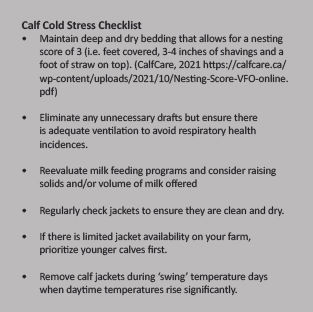
Just because you put a jacket on a calf doesn’t mean it has to stay on 24/7. During periods when nighttime temperatures drop below 50° F and daytime temperatures climb into the upper 60s, leaving jackets on through these swings can sometimes do more harm than good. If a calf still has her jacket on in the afternoon warmth and begins to sweat, it may become damp and enter the cool evenings wet, increasing the risk of cold stress.
Consider using calf jackets once temperatures are below 50° F but be prepared to remove them during the day if temperatures rise significantly. This can be a substantial management commitment, so evaluating the calf benefits and labor commitments of this practice is imperative before finalizing your decision during these “swing” temperature seasons. Once temperatures consistently remain below 50° F, calf jackets can generally be left on full time for younger calves. For older calves, however, it’s better to wait until temperatures drop lower as discussed above, before jacketing consistently (Davis and Drackley, 1998). Regardless of age, be sure that blankets are clean, dry and properly fitted for each calf.
Calf jackets should be viewed as one piece of a larger cold-weather management strategy. Before reaching for a jacket, make sure calves have access to clean, dry, deep bedding that allows for nesting behavior, minimize drafts and ensure nutritional requirements are sufficiently being met. Then, evaluate the individual calves. A six-week-old calf deeply bedded in dry straw may need a little additional support, while a week-old calf may benefit significantly from a jacket.
Calf jackets are a useful management tool, but they work best when paired with good housing, bedding and nutritional practices. At the end of the day, the goal is to keep calves comfortable, healthy and growing as we enter these colder months ahead.
— Abbygail Allen
