

IMPACTS OF NO-TILL CORN PRODUCTION ON NITROGEN LOSSES

In last month’s Farm Report I introduced and discussed the hydrology of an edge-of-field monitoring project that was designed to assess the impacts of no-till corn silage production on field hydrology and nutrient losses. In this article we’ll discuss the impacts the no-till treatment had on nitrogen (N) transport from the field.
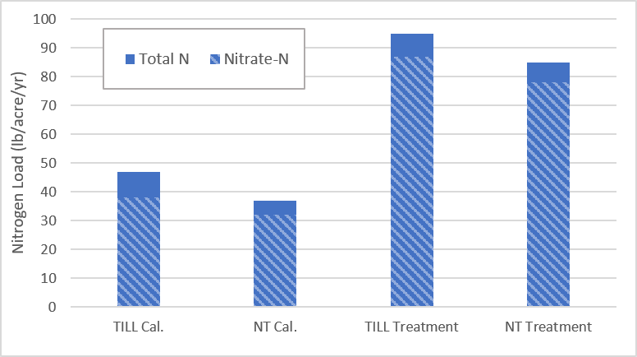
The majority of N was lost from both fields as nitrate in tile drainage throughout the study as seen in the bar graph in Figure A. This was particularly pronounced during the treatment period, which consistently generated higher nitrate concentrations in both fields relative to the calibration period. Because these changes were observed in both the treatment field (TILL) and the control field (NT), they were unrelated to the actual no-till treatment, but rather a consequence of weather conditions favorable for nitrate production in the soil. However, these favorable conditions resulted in very high N losses from both fields, as the rate nearly doubled from the calibration to the treatment period.

This change can be observed in Figure B, where the cumulative nitrate load increased at a fairly steady rate with tile drainage flows until the dotted lines (when the treatment period began), and then the slope of the lines increased for the middle portion, before starting to reduce again in slope to a similar rate as before the dotted lines. If N loading in NT and TILL were primarily driven by drainage volume, the slope of the two lines would remain constant, with N losses occurring at a given rate as tile flows increased. However, we observed similar increases in the slope of the line for both fields, indicating that the tile N concentrations began to increase just prior to the initiation of the treatment period. Approximately two-thirds through the treatment period, the slopes begin to return to what was observed through the calibration period, helping confirm that the change in concentrations occurred at least partially independent of the tillage treatment.
During each of the calibration and treatment periods, 99% of the total N lost from the TILL field occurred in tile drainage. There was a similar trend in the NT field, with 96% and 99% of the total N load generated by tile drainage during the calibration and treatment periods, respectively.
As the majority of the N load was transported via subsurface pathways, most of the total N was comprised of nitrate, a highly soluble and mobile form of N. For TILL, 81 and 92% of total N lost was in the form of nitrate during the calibration and treatment periods, respectively. Similarly for the NT field, 86 and 92% of the total N load was as nitrate during the calibration and treatment periods, respectively.
Ultimately though, the no-till treatment actually increased the amount of N lost from the field. There was a 43% increase observed in nitrate lost from the tile drainage and 41% lost at the field-scale (surface + tile losses). This was actually a bit of a surprise, as we typically assume that tillage will lead to more favorable nitrate-producing conditions and increase the amount of soluble N available in the soil for removal by drainage waters. However, the increase in NT may have resulted from a combination of factors that prevented this from occurring. First, the organic matter levels in NT were greater than in TILL, thus there was a larger pool of mineralizable N in the soil. The second factor was that the no-till treatment resulted in 17% more total event flow from the tiles, and it is well-established that in tile drained fields, as drainage volumes increase, so will N losses.
It is important to recognize that just because we saw undesirable effects in N transport with no-till production, we should not declare the practice a failure. Many of you are likely well aware of the many benefits that reduced or no tillage practices can have on the quality of your soils; we just have to recognize that in some cases we may not be achieving some of the intended water quality outcomes. This helps justify the idea that there is no single silver bullet to our resource conservation concerns. Rather, a thoughtful combination of practices can help offset some of a single practice’s weaknesses and result in a more complete system.
In this case, pairing cover crops with no-till will help draw down nongrowing season (NGS) N levels in the soils which were largely responsible for the N losses observed in this project. Additionally, a cover crop growing throughout the NGS can help reduce drainage amounts by increasing evapotranspiration. Considering we observed over 80 lb/acre of N lost on average from the tiles in both fields during the treatment period, implementing practices such as cover crops that will help retain that N during the NGS can have a strong economic benefit.
Next month I’ll finish up this project discussion and dive into the phosphorus dynamics to see how they compare with the field hydrology and N losses we’ve already covered.
— Laura Klaiber
